Watch the podcast firehose become a brain you can search.
Scroll through every capability, captured live from the app — then join the waitlist, skip the queue on X, or start a 14-day beta trial.
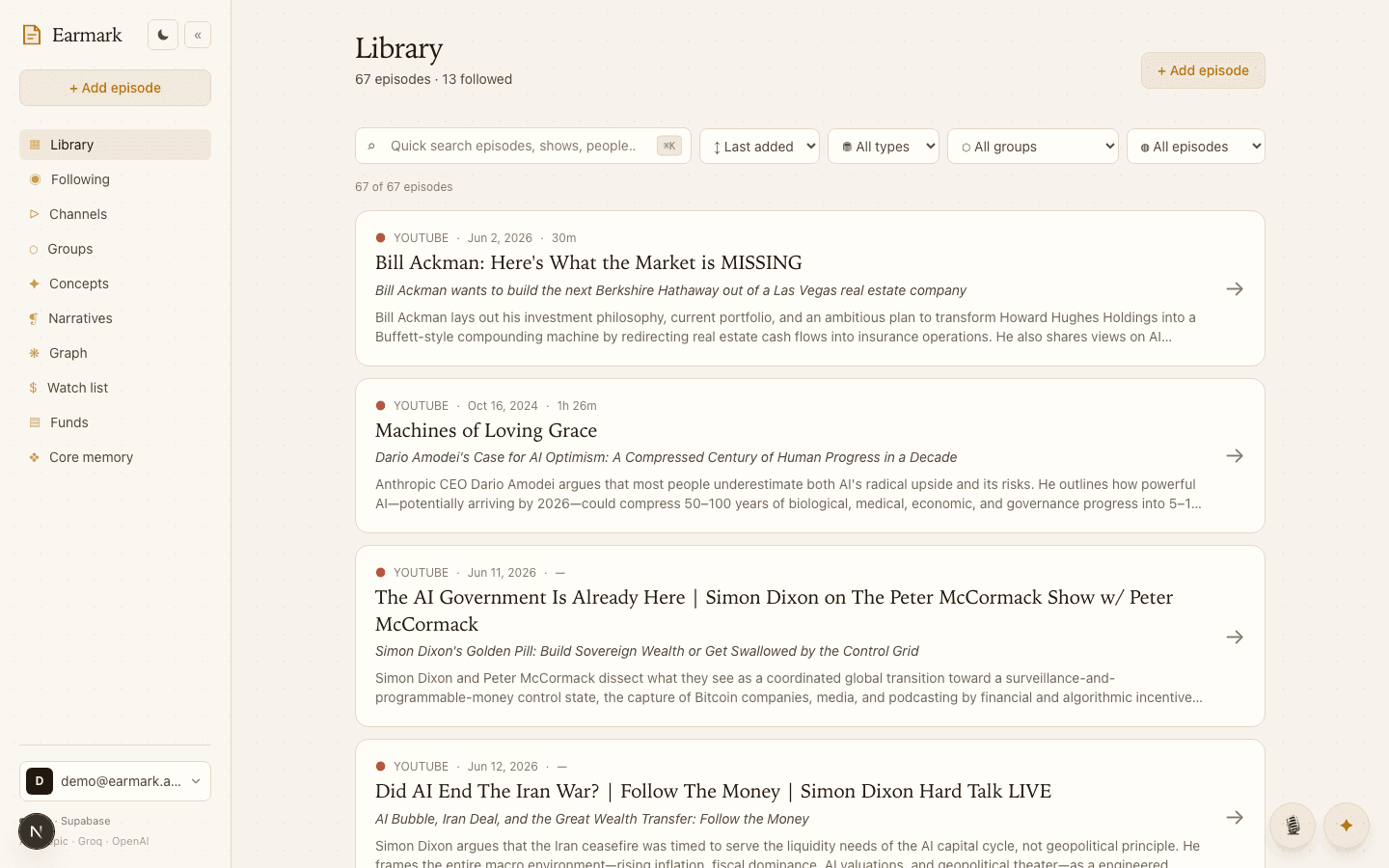
The one-minute tour
Paste a link, watch the knowledge card build itself, and see the library start to compound.
Eight ways it earns its place
Real screens from the app — not mockups. Keep scrolling.
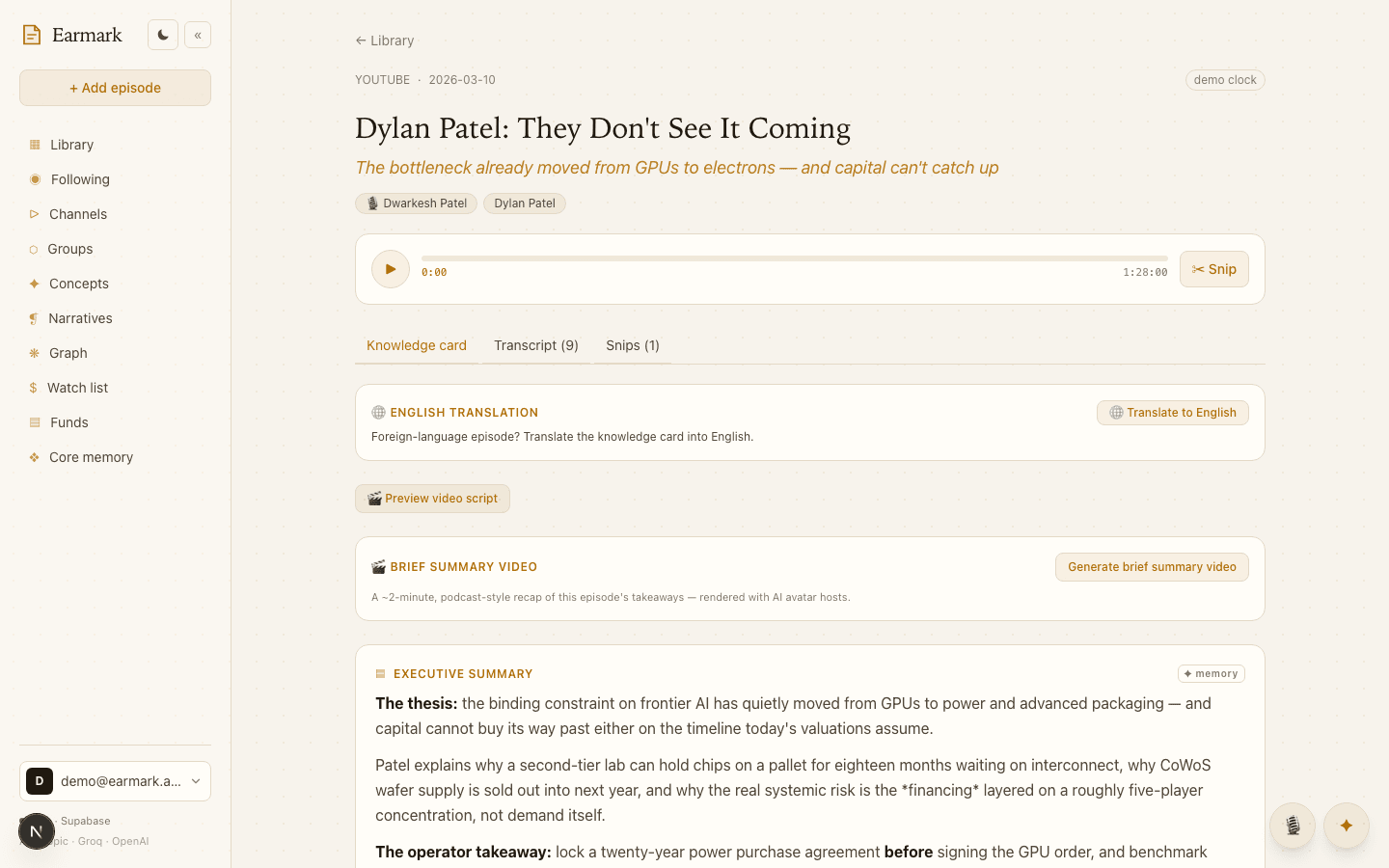
Every minute, dissected and timestamped
Paste any link and Earmark returns an executive summary, then the claims, concerns, frameworks, action items, and verbatim quotes — each one citing a clickable [HH:MM:SS] that jumps straight back to the exact second it was said.
- ✓Executive summary, then the structured breakdown
- ✓Every line cites a clickable timestamp
- ✓One-click Translate to English on any episode
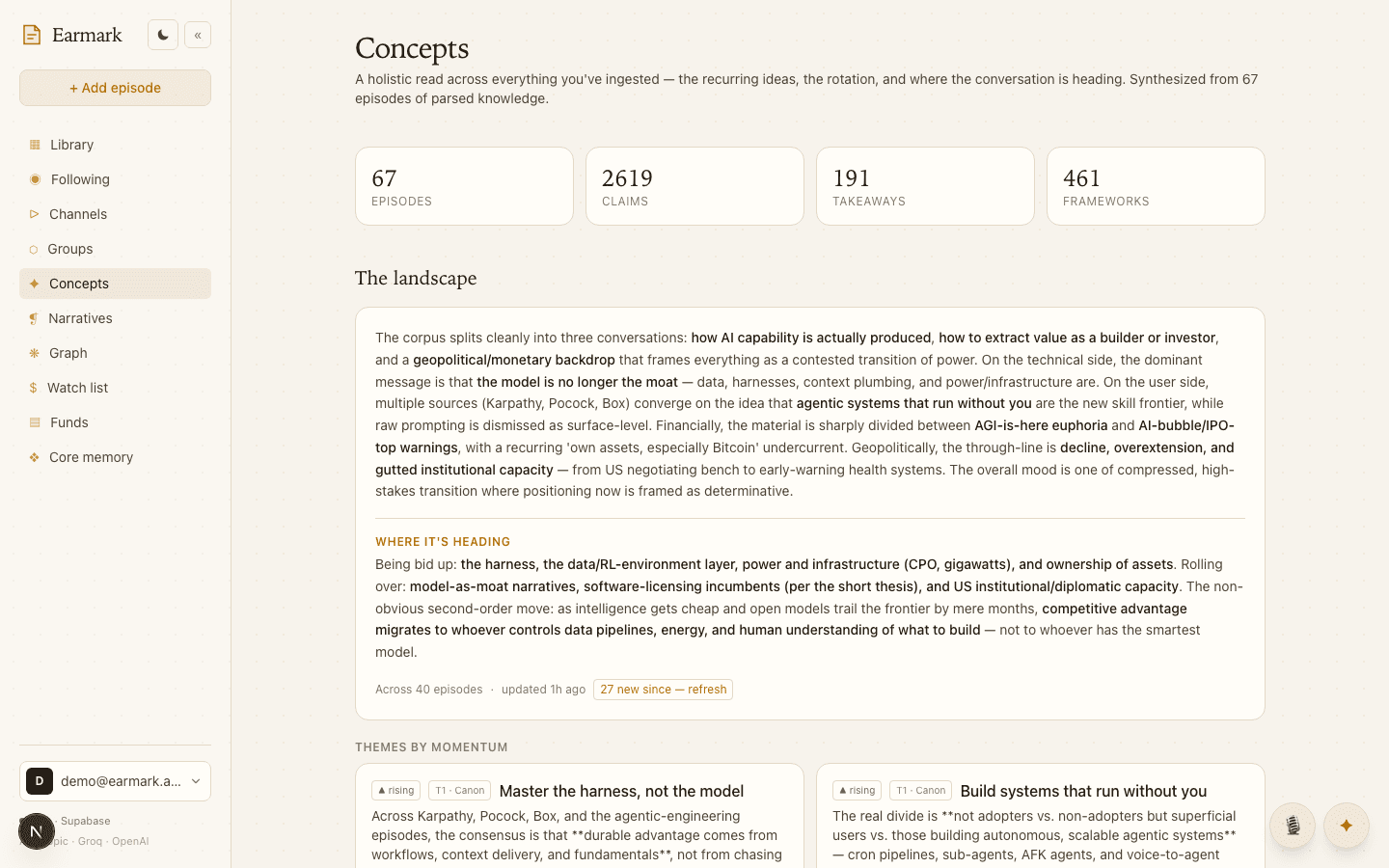
A living synthesis of everything you follow
Claude Opus 4.8 reads across your entire library and writes the through-line — the themes gaining momentum, where the conversation is heading, and the live tensions between your sources. It refreshes as you ingest more.
- ✓Themes ranked by momentum
- ✓Where the conversation is heading
- ✓The tensions where your sources disagree
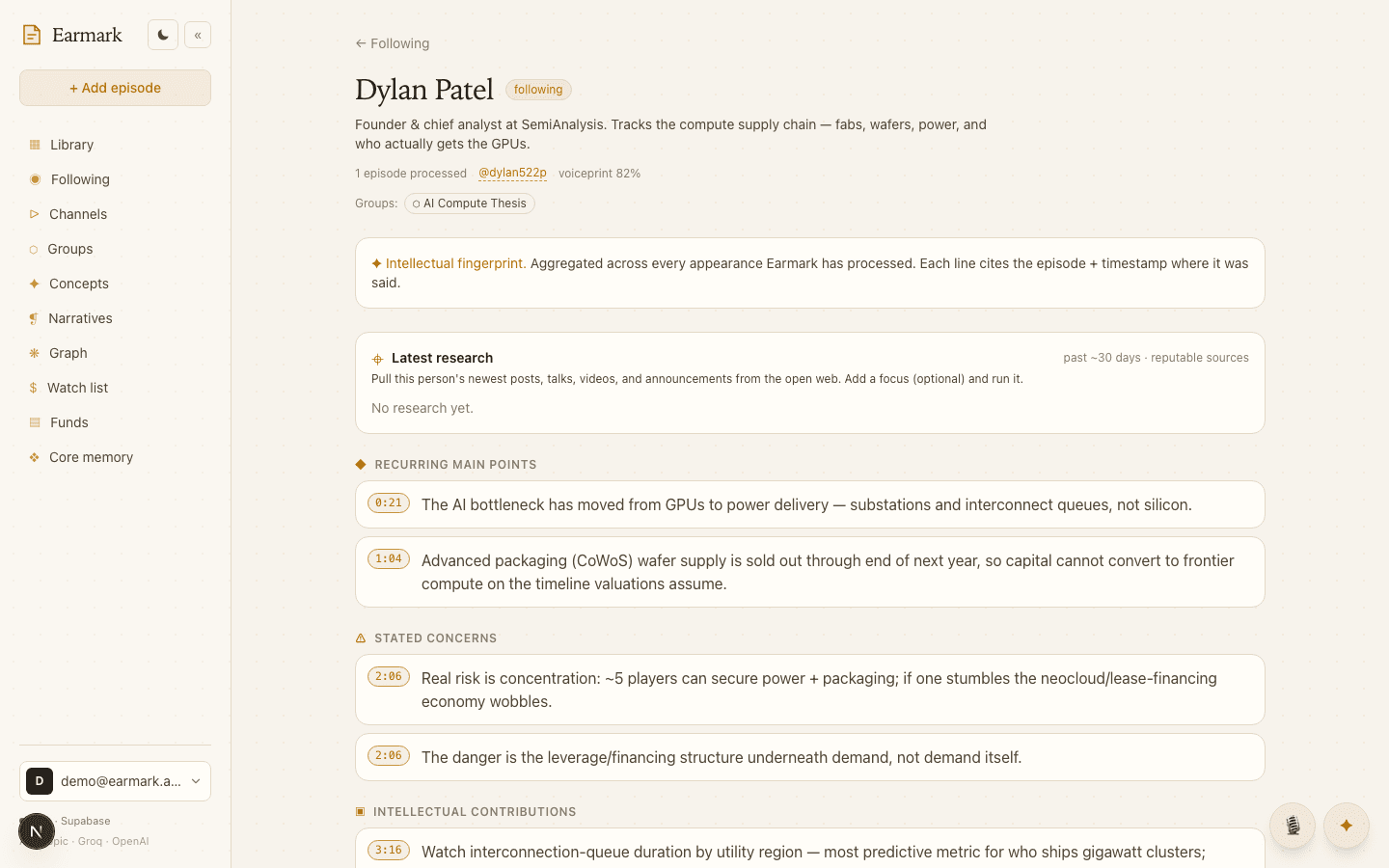
Follow the voices you actually trust
Every appearance someone makes folds into one evolving profile — their through-lines, recurring concerns, and best quotes — so a person becomes a body of thought instead of a pile of scattered clips.
- ✓Compounded across every appearance
- ✓Their sharpest quotes, surfaced
- ✓Fresh research on what they're saying now
The tickers they keep bringing up
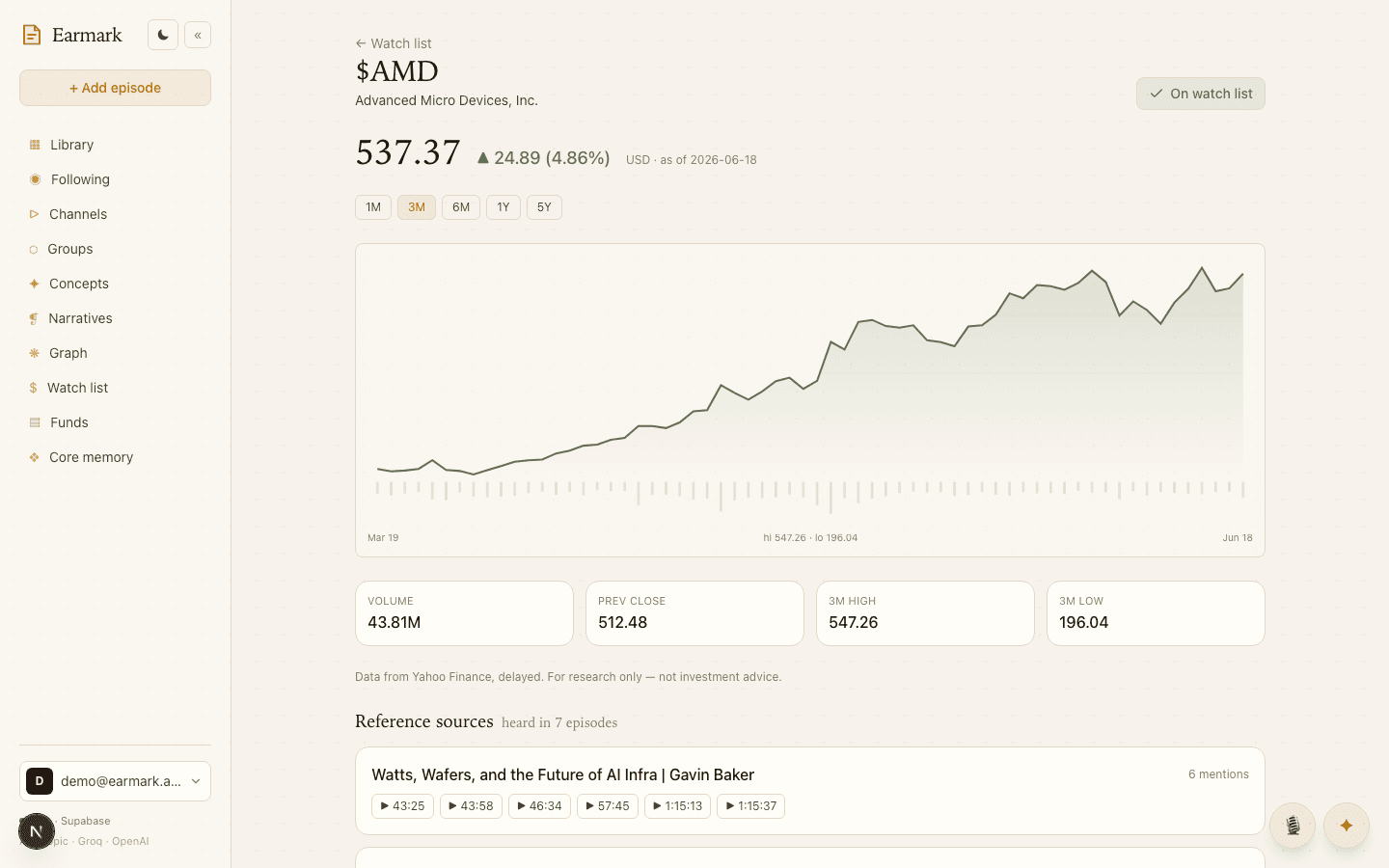
Cashtags like $NVDA are detected across your library and linked to a live price, an interactive chart, and the exact timestamped clips where each call was made — ranked by how often they come up, with import and export.
- ✓Live price and interactive chart
- ✓The clips behind every mention
- ✓Watch lists ranked by mentions
Follow the smart money, from the filings
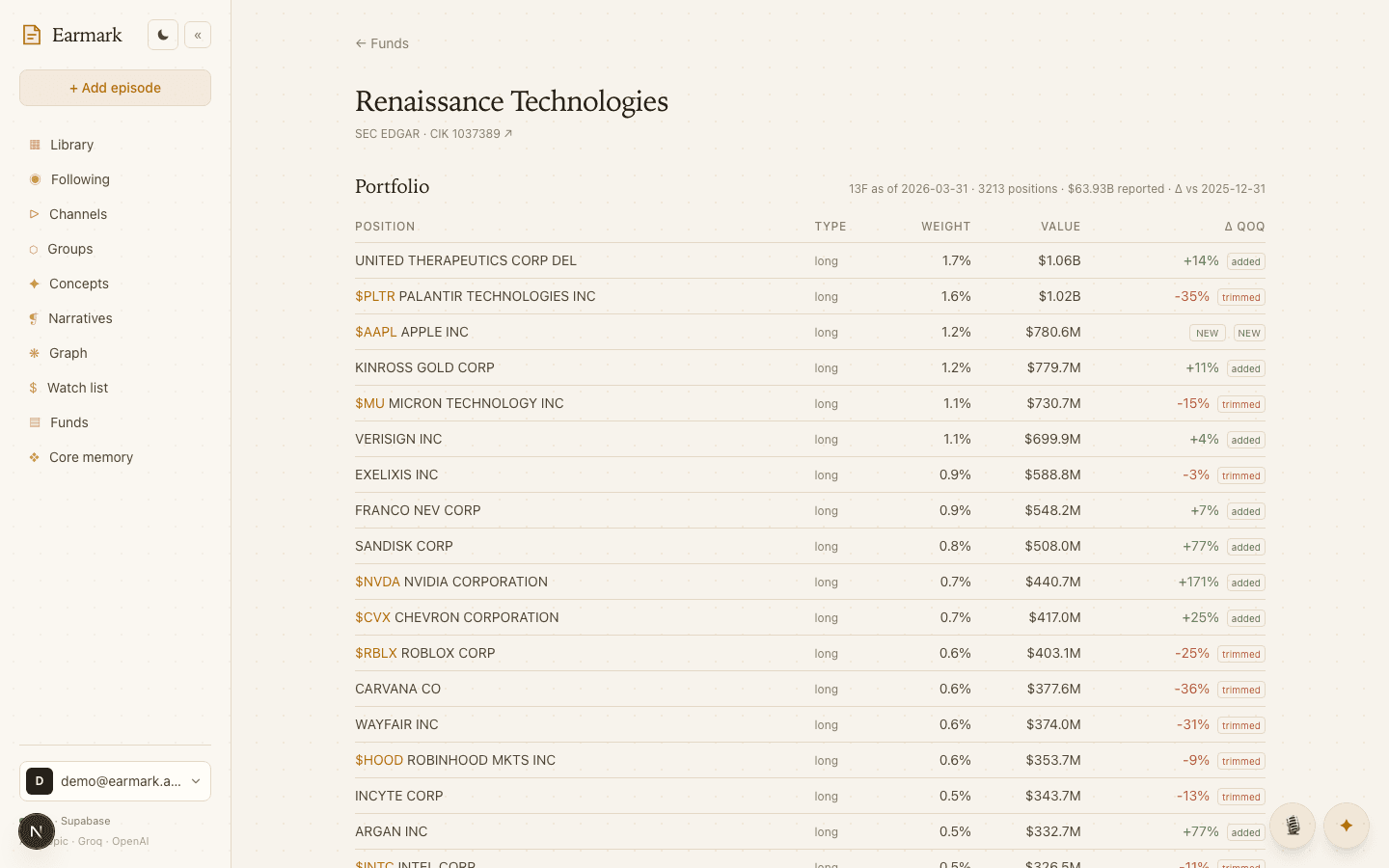
Track 13F managers and read their latest EDGAR holdings with quarter-over-quarter deltas — cross-linked to the episodes and tickers where each manager actually came up. Populate any fund straight from the open web.
- ✓Live EDGAR 13F holdings
- ✓Quarter-over-quarter position deltas
- ✓AI-populate any fund in one tap
See how every idea connects
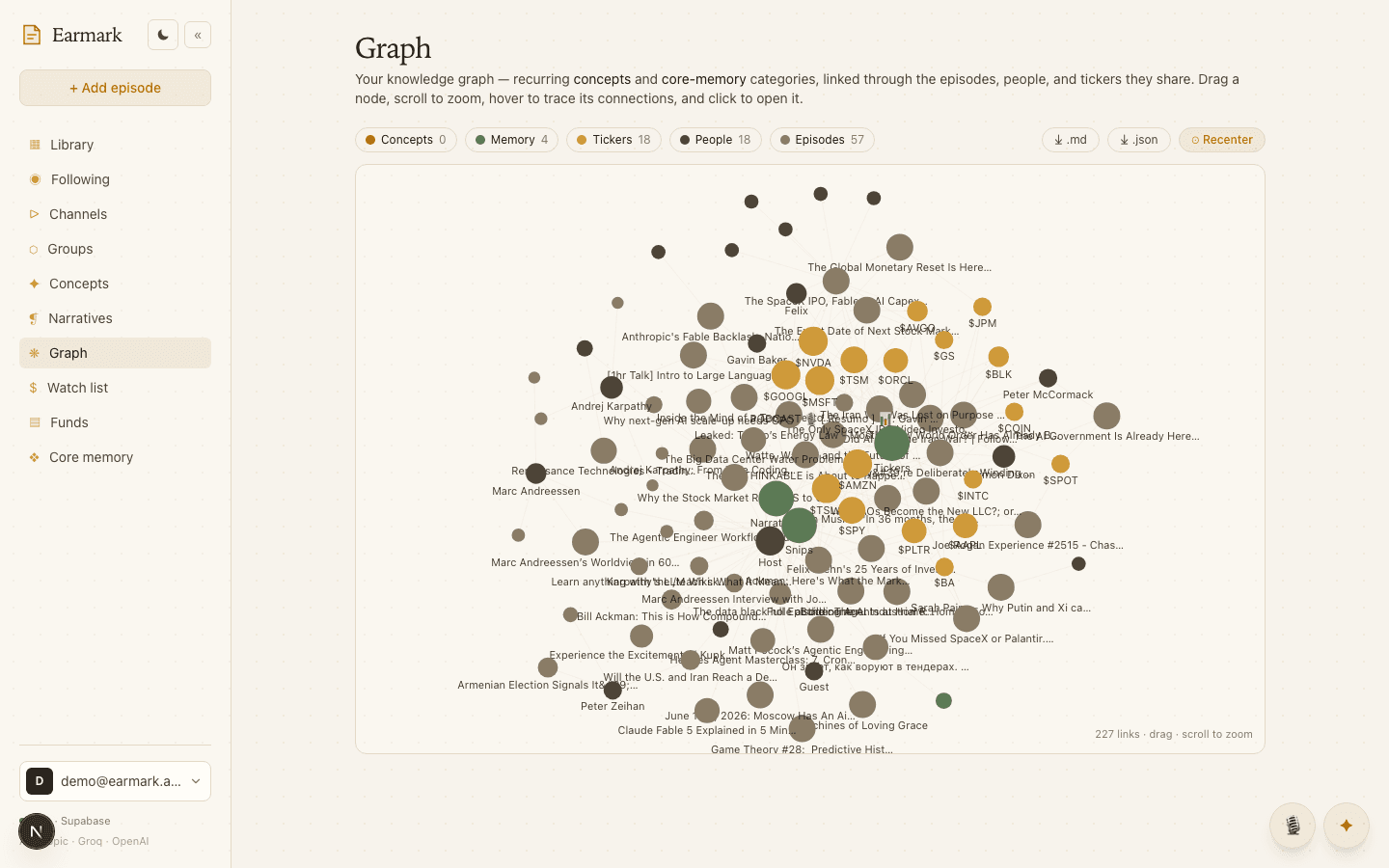
An animated, Obsidian-style graph of your concepts and core-memory categories — wired together through the episodes, people, and tickers they share. Drag, zoom, hover, and click straight into the source.
- ✓Concepts, people, and tickers in one map
- ✓Drag, zoom, and hover to explore
- ✓Click any node through to its source
A brain your AI agents can read
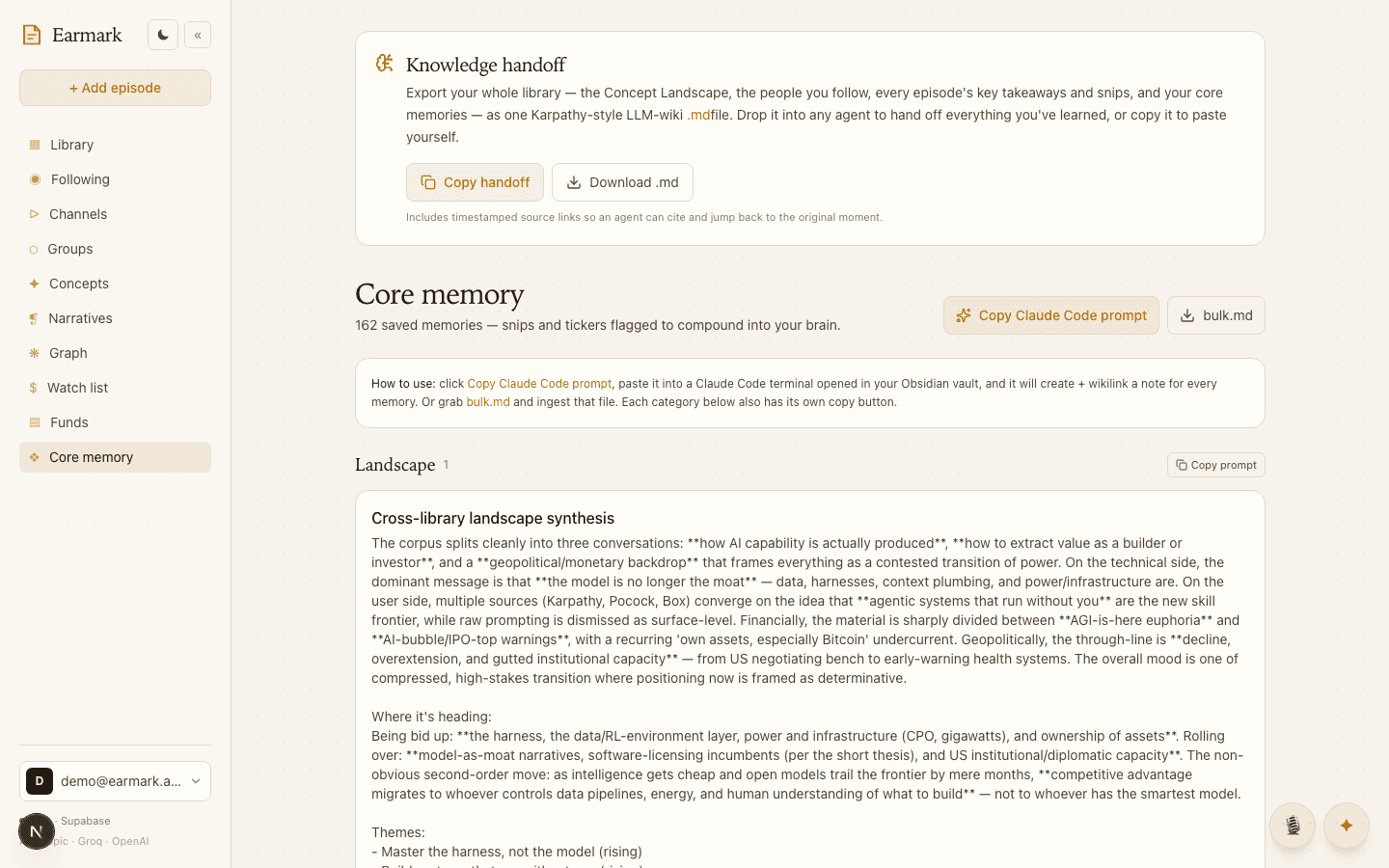
Save any insight, synthesis, or translation to a personal core memory that bridges to your Obsidian vault and Claude Code — then export your whole library as one Karpathy-style LLM-wiki for deeper agentic work.
- ✓Save-to-memory on every unit
- ✓Bridges to Obsidian + Claude Code
- ✓One-file library handoff for agents
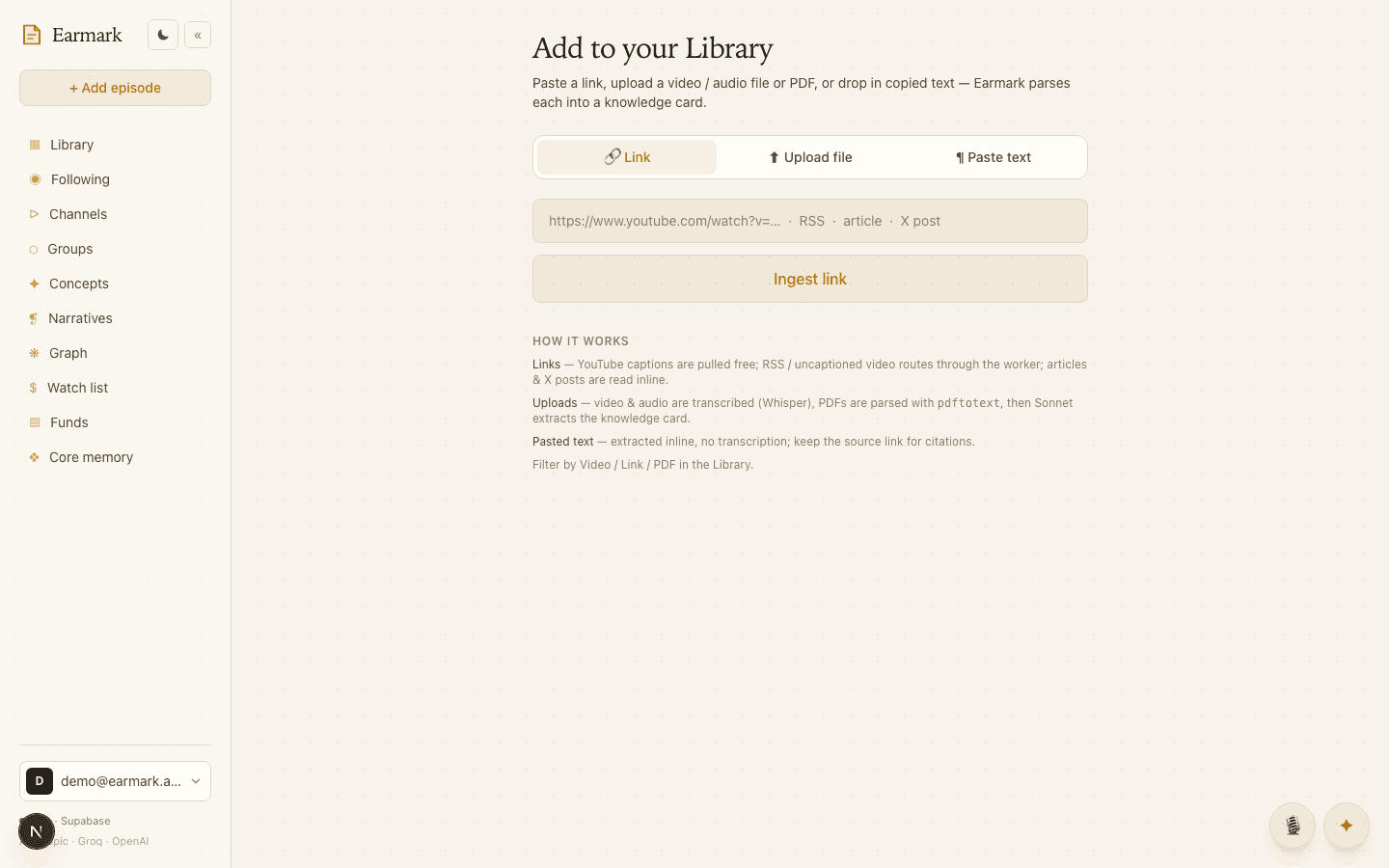
Paste a link. That's the whole workflow.
YouTube, podcast RSS, web articles, and X posts are each probed, then transcribed or text-extracted into the same structured knowledge card — captions-first, so it's free whenever it possibly can be.
- ✓YouTube · RSS · articles · X posts
- ✓Captions-first, audio fallback
- ✓One structured card for all of it
Now your agent can run Earmark
Anything you can do in the app, an agent can do from the command line — authenticated as you. A scoped personal token turns Earmark into a tool your harness drives: push a link to ingest, pull a timestamped knowledge card into your vault, snip a moment, or sync your whole brain — over a CLI, an MCP server, or the REST API.
Developer preview · early accessearmark CLI
A token-efficient command line — add, pull, snip, memory, search, sync — that mirrors your library into your Obsidian vault and Claude Code core memory.
MCP server
Drop earmark-mcp into Claude Code, Claude Desktop, Cursor, or Cline and every action becomes a native tool — push and pull with nothing to memorize.
REST API + tokens
Scoped personal access tokens (read · write · admin) that act as you, with an audit trail — the same identity and permissions as the app.
One brain — readable and writable by your agents
- ✓Push from anywhere — queue a YouTube, podcast, article, or X link without opening the app.
- ✓Pull into your tools — stream a knowledge card as Obsidian-ready markdown with [[wikilinks]] and clickable timestamps.
- ✓Acts as you — a personal token carries your identity, role, and private library; nothing is shared.
- ✓Two-way sync — the existing Obsidian + core-memory bridge, generalized into authenticated push and pull.
{
  "mcpServers": {
    "earmark": {
      "command": "npx",
      "args": ["-y", "earmark-mcp"],
      "env": { "EARMARK_TOKEN": "ear_pat_…" }
    }
  }
}
Add one block to your MCP client — Earmark shows up as a set of tools.
Rolling out to early-access accounts — join the list and we'll send a personal token and the CLI.
More ways the signal gets out
Turn a moment into a share, an episode into a video, and a library into a community.
Share the exact moment
One-tap Snip turns ~45 seconds into a shareable card: a branded share image with the verbatim quote, and a clickable timestamp that drops the viewer into the source video at the exact second.
“The best time to plant a tree was twenty years ago. The second best time is now.”
— Dwarkesh Patel · The macro outlook
- ✓OG share image with the verbatim quote
- ✓A clickable timestamp links into the source video
- ✓A branded 1080² audiogram video for feeds
A 60-second video recap
Generate an AI-hosted video summary of any episode — or your whole Concepts Landscape — with an avatar presenter reading a script written by Claude. Save it to memory or share it.
- ✓Per-episode recaps and a whole-Landscape briefing
- ✓An AI avatar host reads a Claude-written script
- ✓Captioned, savable to memory, and shareable
Publish the whole card
Mark an episode Public and the Share button gives it a page of its own: the full knowledge card — executive summary, TL;DR, every timestamped takeaway, even the video summary — readable by anyone, with a custom OG image built from the TL;DR.
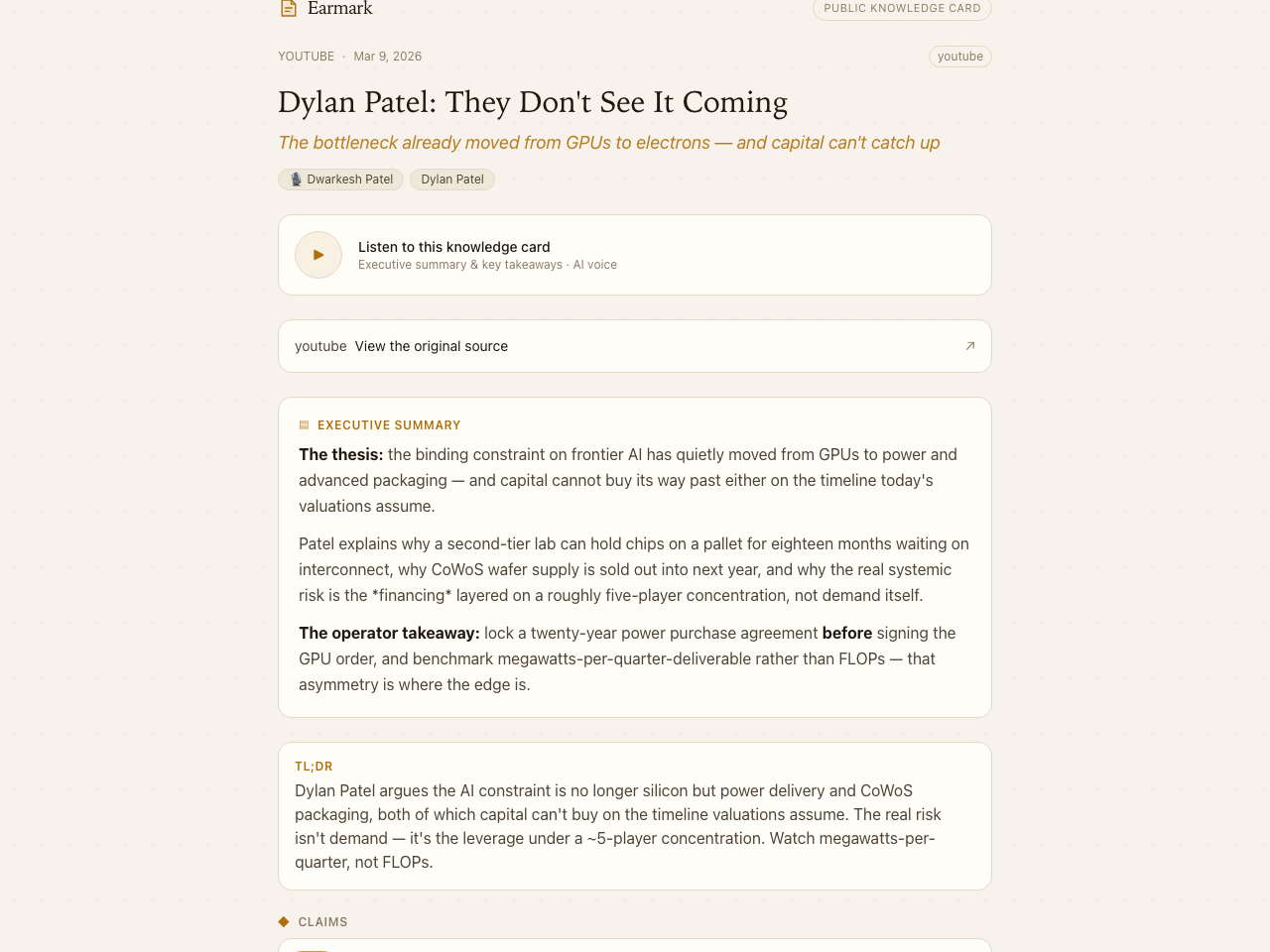
- ✓The full card at a public earmark-ai.com/share link
- ✓A custom OG image — TL;DR + title + source
- ✓Only episodes you mark Public; video summaries are watch-only
Or just press play
Every knowledge card can read itself to you: a warm, human-sounding AI voice narrates the executive summary, the TL;DR, and the key takeaways — on your own episodes in the app (private included) and on every public share page.
- ✓Executive summary → TL;DR → key takeaways, in order
- ✓A warm, natural narrator — not a robot voice
- ✓Renders once, cached forever — instant on replay
Community feed & Trollbox
Publish a submission to the public Community feed for other members to discover — anonymously — and trade takes in the live Trollbox.
Teams
NewCreate your own team and share knowledge with people you trust: invite members by email, share submissions into the private team space, and follow a merged knowledge timeline — full cards, snips, and the concepts the team keeps circling.
The space between just-you and the public feed.
The rest of the toolkit
One-tap Snips
Grab any moment as a shareable clip card with a branded image and a 1080² audiogram video.
Narratives
Highlight any phrase and save it to a priority-ranked store — the lines worth memorizing.
AI chat & voice
An Opus-4.8 assistant that knows your whole library, plus a real-time voice analyst you can talk to.
Channels
Scout a YouTube channel — what it focuses on and its top videos — before you transcribe a thing.
Groups & Suggest sources
Organize people into topics, then let AI surface the leading voices and sharpest critics to follow.
Passwordless & private
Magic-link and passkey sign-in, role-based access, and an owner audit log. Your library stays yours.
Three ways through the door
Join the waitlist for free, skip the line by posting on X, or start a 14-day beta trial and get in today.
One email works for every option below. No password — sign in later with a magic link or passkey.
Get in today
No waiting, no posting — start a 14-day free trialand unlock the whole platform now. Cancel anytime before it ends and you won't be charged.
Enter your email above to start
We'll attach your 14-day trial to it and take you straight to checkout.
Post on X, jump the queue
On a budget? Post about Earmark, paste the link back, and we bump you toward the front — free.
Post & skip the queue“I just signed up for Earmark to organize the tsunami of podcasts and ingest them straight into my agentic harness. 🎧→🧠”
Not ready? Join the free waitlist
Reviewed case by case — we email an invite as seats open.
Beta access starts a 14-day free trial; cancel anytime before it ends and you won't be charged. By starting a trial you agree to our Terms and Privacy Policy. Payments are processed securely by Stripe.
Frequently asked
What is Earmark?+
Earmark is a personal podcast-intelligence OS. Paste a YouTube video, podcast, article, or X post and it transcribes the source, then compiles a timestamped knowledge card — summary, claims, frameworks, and verbatim quotes — that you can search, clip, and compound with everything else you follow.
What can I ingest into Earmark?+
YouTube videos, podcast RSS feeds, web articles, and X (Twitter) posts. Earmark transcribes audio and video — captions-first, so it's free when captions exist — or extracts article text, then turns all of it into the same structured knowledge card.
How accurate are the timestamps?+
Every claim, framework, and quote on a knowledge card cites a clickable [HH:MM:SS] that jumps back to the exact moment in the source, so you can verify any line in a single tap.
Is my library private?+
Yes — your library is private by default. Every podcast you ingest, and everything Earmark derives from it (its knowledge card, your snips, the concept Landscape, person rollups, narratives, and core memory), is visible only to you. Other members — and the demo account — can't see it. You can choose to publish an individual submission to the public Community feed, and pull it back to private at any time. Sign-in is passwordless (magic-link + passkeys) with role-based access and an owner audit log.
What is the Community feed?+
A place to share. When you publish a submission, it appears in the Community feed for other members to discover — without exposing the rest of your private library, and without revealing who shared it. Everything you don't publish stays siloed to your account.
How much does Earmark cost?+
There is a free waitlist, and a beta plan at $4.39 per month or $45 per year that starts with a 14-day free trial you can cancel anytime before it ends.
Can my AI agents use Earmark?+
Yes — and they can act, not just read. Earmark bridges to your Obsidian vault and Claude Code, exports your whole library as a single LLM-wiki file, and (in developer preview) exposes a command-line tool and an MCP server so an agent can push links to ingest and pull knowledge cards back — authenticated as you with a scoped personal access token.
Does Earmark have a CLI or an API?+
Yes. An agentic command-line tool (the earmark CLI), an MCP server, and a versioned REST API let you push and pull content programmatically — add an episode, create a snip, save a memory, or pull a timestamped knowledge card as Obsidian-ready markdown. Access is gated by scoped personal access tokens that carry your own identity and permissions. It is rolling out as a developer preview.
How does Earmark work with Claude Code, Claude Desktop, and Cursor?+
Earmark ships an MCP server (earmark-mcp) and a Claude Code skill, so the actions you take in the app become native agent tools. From your harness you can say things like “queue this podcast” or “pull today’s frameworks into my notes,” and Earmark runs them over the API as you — then syncs the results to your Obsidian vault and core memory.
Can I share a clip or moment with someone?+
Yes. One-tap Snip turns the last ~45 seconds into a shareable card — a branded share image with the verbatim quote and a clickable timestamp that opens the source video at the exact second, plus a 1080² audiogram video. You can also publish a whole submission to the public Community feed or trade takes in the live Trollbox.
Can I share a whole knowledge card publicly?+
Yes. Mark an episode Public and the Share button publishes its full knowledge card — executive summary, TL;DR, every timestamped takeaway, and any already-rendered video summary — at its own earmark-ai.com/share link with a custom OG image built from the TL;DR. Visitors can even listen to the card. Private episodes are never reachable.
Can Earmark read a knowledge card to me?+
Yes. Every card has a Listen player: a warm, human-sounding AI voice narrates the executive summary, the TL;DR, and the key takeaways — on your own episodes in the app (private included) and on public share pages. Narrations render once and are cached, so replays are instant.
Can I generate a video summary of an episode?+
Yes. Earmark generates an AI-hosted video recap — an avatar presenter reading a script written by Claude — for any episode and for your whole Concepts Landscape. Save it to memory or share it.
Are Teams available?+
Yes. Create a team, invite members by email (the invite itself grants sign-in), and share submissions into the private team space — every member sees the full knowledge card and its snips, plus a merged timeline and the concepts the team keeps circling. Owner, member, and viewer roles control who can share.